
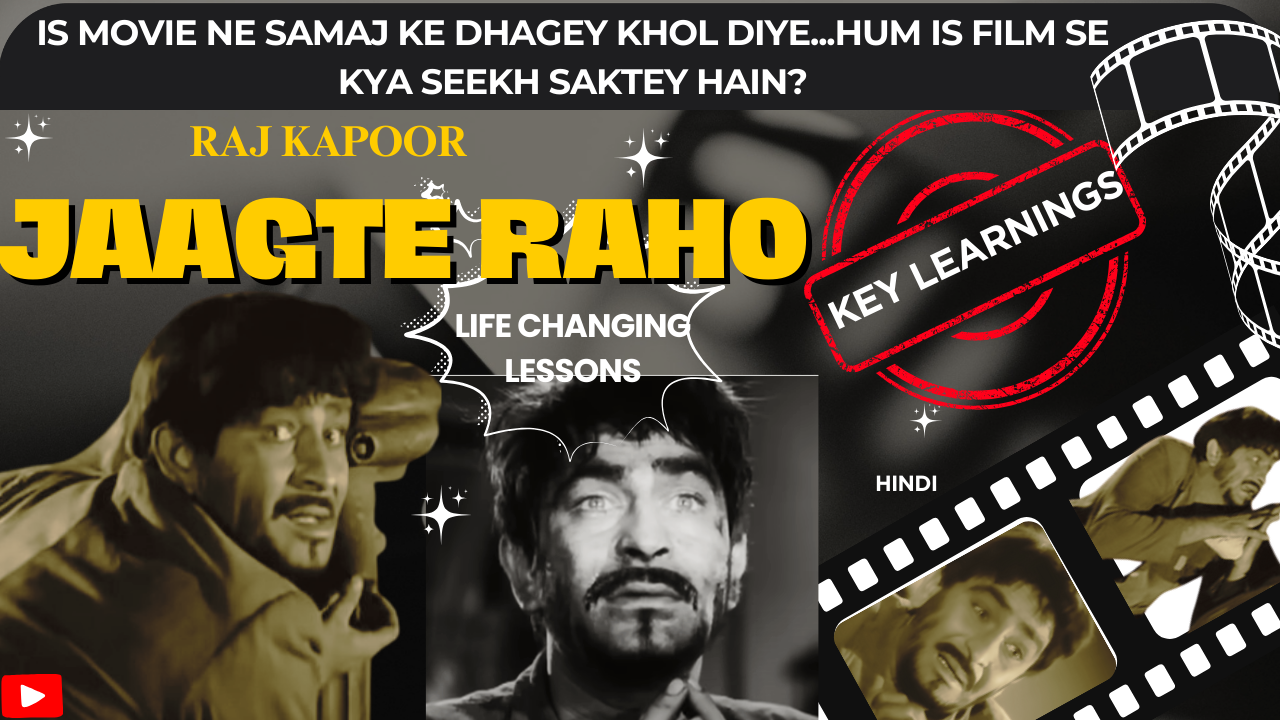
“A person is not always what they appear to be.” – This is the harsh truth that the 1956 classic Jaagte Raho masterfully unveils. Directed by Amit Maitra and Sombhu Mitra, and starring the legendary Raj Kapoor, this film is much more than just a thriller—it is a deep reflection of society, hypocrisy, and human nature.
Imagine stepping into a new city, filled with dreams and hope for a better life. But instead of opportunities, you are met with fear, judgment, and accusations. This is exactly what happens to the protagonist in Jaagte Raho.
Raj Kapoor plays a poor laborer who arrives in the city at night, desperately searching for water. When he enters a building complex to quench his thirst, the residents mistake him for a thief. What follows is a night-long struggle where he hides from one home to another, witnessing the hidden realities behind the closed doors of so-called respectable people. The so-called “civilized” society is shown to be filled with deceit, hypocrisy, and corruption.
His journey finally ends at dawn when he finds solace and kindness in a temple, where a woman (played by Nargis) offers him water, symbolizing hope, purity, and compassion. The film, through its gripping storytelling, leaves us with some powerful takeaways that are more relevant than ever today.
Watch My YouTube Video on Jaagte Raho Learnings 👇
Don’t forget to like, share, and subscribe for more insights on classic cinema and life lessons!
YouTube Channel: Personal Progress Pages (English)
YouTube Channel: Personal Progress Pages Hindi
Key Learnings from Jaagte Raho
1. First Impressions Can Be Deceptive
The film begins with an eye-opening truth—people are quick to judge. Just because the protagonist looks different, he is instantly labeled a criminal. His attire and poverty become his identity in the eyes of society.
He does not belong to city….”He does not belong”…Isn’t this something we still see today? The game of Belonging is eating up most from within.
Social media has only made this worse. People judge others based on their appearance, clothing, or the way they speak. But true character is much deeper than the surface. Before forming opinions about someone, we must pause and reflect—are we seeing the truth or just an illusion?
2. Show-Off Culture: What You See is Not Always Real
Throughout the movie, the protagonist peeks into various apartments and discovers the double lives of the residents. Outwardly respectable, these individuals are engaged in deceit, infidelity, and dishonesty. It reminds us of today’s world, where people project a perfect life on social media, but reality is far from it.
As the famous saying goes, “Jo dikhta hai, wahi bikta hai” (What is visible, sells). The film forces us to question—are we also becoming victims of this culture of appearances? Are we prioritizing how we look in the eyes of others instead of focusing on who we truly are?
3. The Class Divide – The Rich Get Richer, The Poor Stay Struggling
One of the strongest messages of Jaagte Raho is the growing divide between the rich and the poor. The wealthy control the city, the businesses, and even public opinion, while the poor remain helpless, judged, and exploited.
Even in today’s times, this cycle continues. Big brands and corporations dictate our choices—what to wear, where to eat, what to buy—while middle-class and poor people struggle to keep up. Have you ever thought about how we are being programmed to consume more and work harder for things we don’t actually need?
4. Patience and Determination Lead to Victory
Despite all odds, the protagonist never gives up. He fights through the entire night, hiding, running, and struggling, but he survives. Finally, at dawn, he finds hope, proving that every struggle is temporary.
This is an essential lesson for all of us. No matter how tough life seems, with patience and determination, we can overcome any obstacle. Problems are like the night—long and dark—but the morning always comes.
Why Jaagte Raho is Still Relevant Today
Even though Jaagte Raho was made in 1956, its themes of judgment, hypocrisy, materialism, and resilience are timeless. The movie forces us to reflect on our own behavior—are we quick to judge? Are we obsessed with appearances? Are we blind to the struggles of the less fortunate?
This film is a reminder to stay awake (jaagte raho)—not just physically, but mentally and socially. It urges us to look beyond the surface, challenge societal norms, and embrace empathy over prejudice.
If you haven’t watched this gem yet, I highly recommend it. And if you have, watch it again, this time with a deeper perspective.